Who was Oscar Wilde?
Poet, playwright, wit and proud Dubliner.
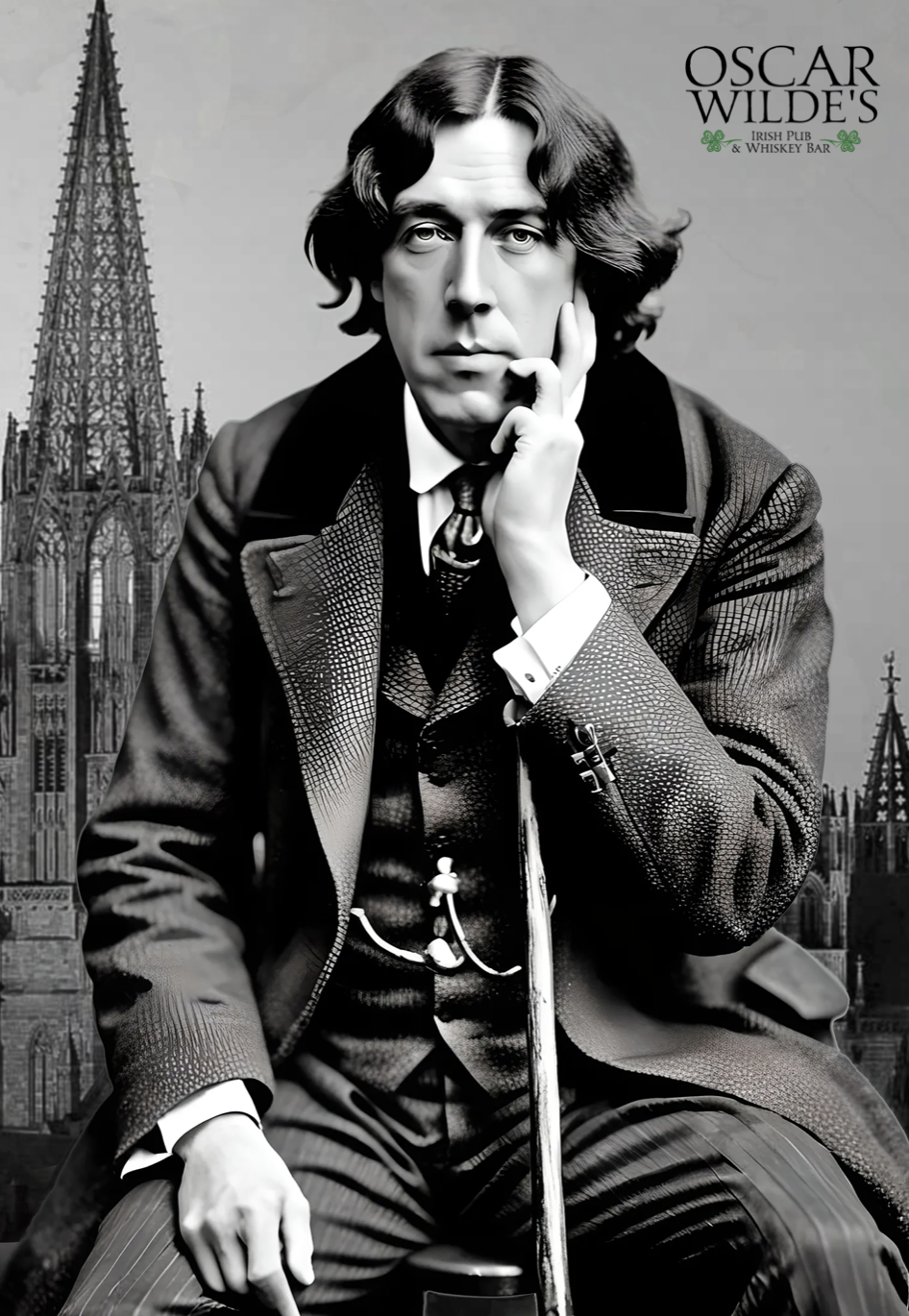
Oscar Fingal O'Flahertie Wills Wilde was born in Dublin on 16 October 1854 and grew up to become one of the most celebrated writers of his age: a poet, playwright and storyteller, a dazzling talker, and a man who believed that life should be lived with beauty, generosity and a sense of humour. When we looked for a name for a pub that loves good food, fine whiskey and Irish literature, there was only ever one candidate.
- 16.10.1854Born in Dublin
- WitThe most quotable Dubliner
- Trinity & OxfordScholar and prize winner
- 30.11.1900Died in Paris
The Picture of Dorian Gray
Oscar Wilde wrote one novel. It tells of Dorian Gray, a young man so beautiful that he wishes his portrait could grow old in his place. The wish comes true: every unkind deed and every wasted year settles on the canvas, while he stays fresh-faced.
Scroll down the page, or drag the slider, and watch our own painting do the same.
An imaginary gentleman, drawn for this page. Not a portrait of any real person.
A Dubliner through and through
Oscar grew up in a lively, literary household in the heart of Georgian Dublin. His father, Sir William Wilde, was a celebrated surgeon and a passionate collector of Irish history and folklore. His mother, Jane Wilde, wrote patriotic poetry under the name Speranza and hosted one of the city's best-known salons, where writers, scientists and artists talked and laughed late into the night. It was the perfect school for a boy who would become the finest conversationalist of his time.
He studied at Portora Royal School in Enniskillen and then at Trinity College Dublin, where he won a scholarship and the Berkeley Gold Medal for Greek.
Oxford and the love of beauty
In 1874 Oscar won a scholarship to Magdalen College, Oxford. He graduated with the highest honours, won the Newdigate Prize for poetry in 1878, and became the best-known voice of the Aesthetic movement: art for art's sake, beautiful rooms, beautiful words and a life lived with style. That love of beautiful surroundings is something we have tried to bring into our pub.
A star on the road
In 1882 Oscar set off on a lecture tour of North America that lasted almost a year, from New York to San Francisco. Audiences adored him. One of the best-loved stories says that in Leadville, Colorado, he lectured to a hall full of miners and was welcomed by them with a glass of whiskey. We cannot swear to every detail, but we like to think it is true.
Stories, plays and one unforgettable novel
In little more than a decade he wrote:
- The Happy Prince and Other Tales (1888) and A House of Pomegranates (1891): fairy tales that children and grown-ups still love
- The Picture of Dorian Gray (1890, expanded 1891): his only novel and one of the most famous stories in the English language
- Lady Windermere's Fan (1892), A Woman of No Importance (1893) and An Ideal Husband (1895): sparkling comedies that made him the toast of London
- The Importance of Being Earnest (1895): often called the funniest play in the English language, and still performed on stages all over the world
- Salome (written in French in 1891), poems, essays, and The Ballad of Reading Gaol (1898)
In early 1895 two of his plays were running in London's West End at the same time, and the whole city was quoting him.
In his own words
I can resist everything except temptation. (Lady Windermere's Fan)
We are all in the gutter, but some of us are looking at the stars. (Lady Windermere's Fan)
To love oneself is the beginning of a life-long romance. (An Ideal Husband)
Moderation is a fatal thing. Nothing succeeds like excess. (A Woman of No Importance)
Experience is merely the name men gave to their mistakes. (The Picture of Dorian Gray)
I have the simplest tastes. I am always satisfied with the best.
Courage, and a legacy that grew
Oscar's last years were hard, but his spirit and his writing proved stronger than everything that was thrown at him. The Ballad of Reading Gaol, written after his release, became one of the most widely read poems of its day, and De Profundis, the long letter he wrote from prison, is still read and loved. He died in Paris on 30 November 1900, aged 46, and is buried at Père Lachaise cemetery, where admirers from around the world still come to visit him. In 2017 a new British law pardoned him, together with thousands of other men, for convictions that today would be unthinkable.
Dublin remembers
In Dublin you can sit beside Oscar in the corner of Merrion Square, where a colourful sculpture shows him reclining on a rock, directly opposite his childhood home at number 1. Trinity College, where he studied, runs the Oscar Wilde Centre for creative writing in the house on Westland Row where he was born. He is one of the writers Ireland is proudest of.
Why our pub carries his name
Oscar loved good company, good conversation, beautiful rooms and, so the story goes, a good drop of whiskey. We have tried to make a pub he would have been happy to walk into: a place to talk, laugh, argue and linger. That is why his portrait looks down from our mantelpiece, why our whiskey list is as long as one of his conversations, and why every Monday we ask you to prove how much you know. Come in, raise a glass to the man himself, and take a seat.